 By admin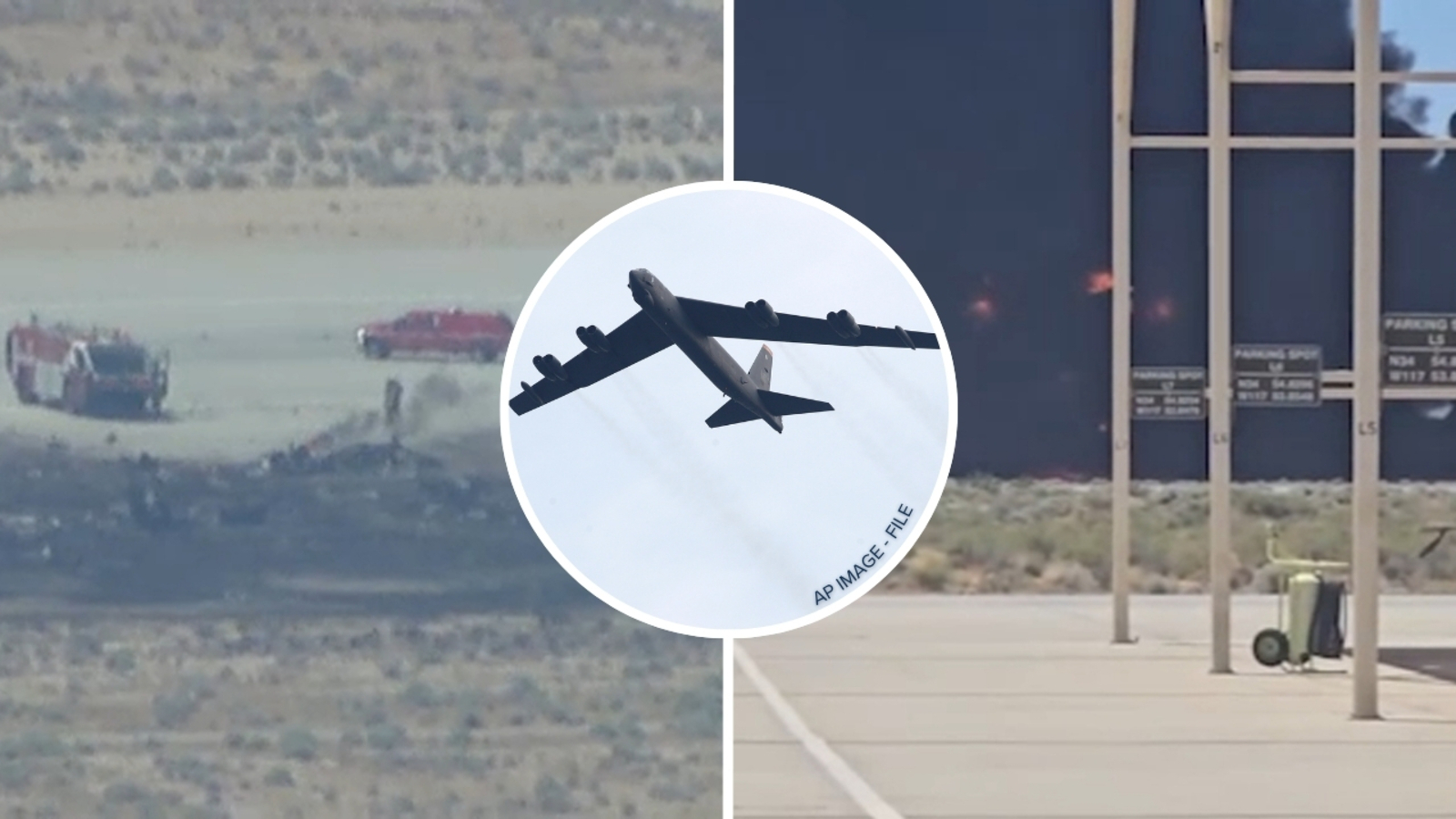
EDWARDS AFB, Calif. (KABC) — A crew of eight people died after an Air Force B-52 Stratofortress crashed shortly after takeoff from Edwards Air Force Base in Kern County, located northeast of Lancaster, officials confirmed Monday. The Air Force Base said the crash happened during a “routine test mission.”
Read more Evacuation order lifted after brush fire threatens homes in Stevenson Ranch
“An Air Force B-52 Stratofortress carrying eight people on a routine test mission crashed today shortly after take-off at 11:20 a.m. (PDT). Initial indications are that the crash was not survivable. Emergency response personnel are on scene, and officials are working to account for all personnel. The crash is currently under investigation,” the base wrote in a statement.
The base is located in the Mojave Desert, about 100 miles north of Los Angeles.
At a press conference on Monday afternoon, officials confirmed that eight lives were lost. The victims were described as a mixed crew of uniform military, government civilians and government contractors. Their names were not immediately released as officials work to notify next of kin.
In a statement, Boeing confirmed that two of its employees were on board.
“We extend our deepest condolences to the loved ones of the eight crew members who lost their lives in the B-52 crash at Edwards Air Force Base, California. It is with great sadness that we confirm two Boeing employees were among those on board. We are in contact with their families and are offering support,” Boeing wrote.
“We lost eight great Americans. This crash is deemed to be unsurvivable, and right now, our thoughts and prayers are with the families of those who lost their loved ones,” Colonel James Hayes said at the press conference.
Hayes said the B-52 bomber crashed shortly after takeoff for a mission supporting the “Radar Modernization Program,” which he described as a local test mission. Upon impact, the aircraft instantly burst into flames.
First responders quickly took action to extinguish the blaze. Officials reviewed the footage of the crash and deemed it unrecoverable and unsurvivable. Hayes noted that test missions take place every day, multiple times a day, at the Air Force Base.
AIR7 flew over the runway at the Air Force Base, where the still-smoldering charred debris of the B-52 bomber was visible. It appeared that what was left of the bomber was mostly ash.
Just a few hundred yards away from the crash site, an intact B-52 bomber was seen in AIR7 video.
Shocking cellphone video shows a massive amount of smoke and fire immediately after the crash.
Read more B-52 bomber crashes after takeoff from Edwards Air Force Base, officials say
“At this point, we don’t have any indication as to what the cause was of this. We won’t be able to release that information, and we don’t have an availability to get that anytime soon,” Hayes said.
Investigators are now digging through the debris field for the aircraft’s black box and other equipment on board that could provide vital clues as to what went wrong.
Officials said an interim safety board is doing an initial gathering of facts, which will then be handed to a safety investigation board, which will look into the root causes of the crash. He said that process will take about 30 days.
Then, those findings will be sent to an accident investigation board, which will determine what information can be released to the public and next of kin. That process can take upwards of six months, Hayes said.
Operations at Edwards Air Force Base are on hold as the investigation continues on the runway.
The Air Force and NASA regularly conduct test flights of new and developmental aircraft at Edwards Air Force Base.
The B-52 Stratofortress — which typically carries a crew of five — is a long-range bomber first introduced in the 1950s that remains a central part of the U.S. military’s air power. Built by Boeing at a cost of at least $84 million, the aircraft is capable of carrying both conventional and nuclear weapons over long distances and has been used in conflicts ranging from Vietnam to operations in the Iran war. It can fly 8,800 miles without refueling and can carry heavy payloads, making it a vital military aircraft.
“It’s a part of the backbone of the nuclear triad for the United States military. That involved submarine-launched missiles, we have the intercontinental ballistic missiles, and then we have the long-range ballistic missiles of which B-52s are part of,” said Luis Martinez, ABC News’ senior Pentagon reporter.
Read more California Gov. Gavin Newsom says Department of Justice is investigating him and his wife
ABC News contributed to this report.